Milton Paulo
Biography
Dancer, Improviser, Teacher
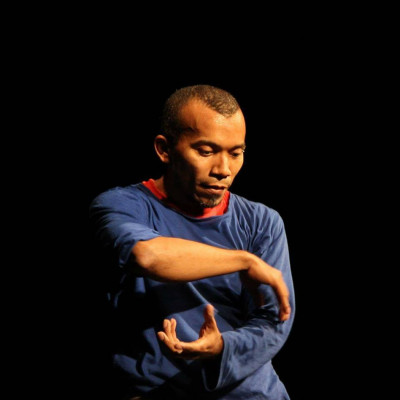
Originally from Brazil, Milton Paulo began his career with a multidisciplinary immersion in acrobatics, circus arts, street theatre and clowning, complemented by parallel training in contemporary dance at the Colégio de Dança do Ceará. From the outset, he perceived the body as a true vehicle for personal and collective transformation. This vision led him to enrich his practice with numerous movement techniques, improvisation and somatic approaches (Laban/Bartenieff, Body-Mind Centering, Contact Improvisation).
His career as a performer and choreographer demonstrates his great versatility and a strong taste for interdisciplinarity. In Belgium and abroad, he collaborates with French-speaking creators such as Claudio Bernardo, Frédéric Flamand, Bud Blumenthal, Félicette Chazerand and Marie Martinez. At the same time, he has been passionately involved in the young audience sector, collaborating with the Théâtre de la Guimbarde, the Cie Parcours, the Infusion asbl and the Collectif Cil, where he explores contemporary, poetic and sensitive forms adapted to the youngest audiences. His work has also been featured in prestigious museum contexts, notably at the Magritte Museum and the Royal Museums of Fine Arts of Belgium.
As an educator, Milton Paulo has been generously and systematically imparting his knowledge for nearly 30 years. With a wealth of experience ranging from professional training (R.I.A, ISADAC in Morocco, Royal Conservatory of Liège) to awareness-raising in schools (Ekla, Pierre de Lune), he has been able to adapt his tools to a variety of audiences. He currently puts his expertise to work in higher education as a lecturer in the Bachelor's programme in Rhythms and Rhythmics (BaRR) at the Conservatoire royal de Bruxelles, where he helps students develop their stage presence and physicality.
His current artistic approach focuses on improvisation and instant composition, particularly within the MΣAL Collective. His teaching emphasises the transmission of tools for a detailed understanding of the architecture of movement in space. By integrating his somatic knowledge, he guides performers towards mastery of different dynamics and a keen awareness of movement phrasing. His approach aims to offer a clear reading of the body's structure, thus allowing for greater creative freedom and a profound experience of the potential and richness of the body in motion.