James Munro
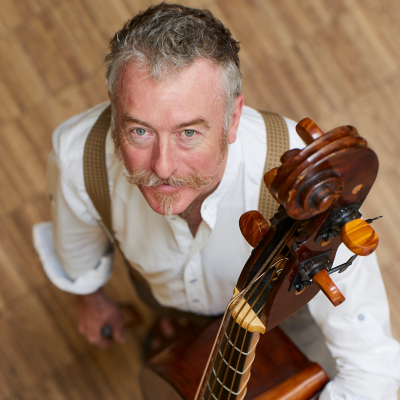
Biography
Why play on historical instruments? What is the advantage of playing on gut strings or with a historical bow? Why bother learning to play on a historical tuning? These fundamental questions, and many others – usually asked by others! – only arose many years after James Munro began his personal journey of discovery as a “historically informed” musician and incorporated all these elements into his individual approach to music, sound itself and their potential as a bass player.
Having started his musical life as a keyboard player, James Munro ‘accidentally’ switched to the double bass as a teenager and was immediately captivated by the intrinsically fundamental and inclusive nature of the instrument, which symbolises and functions as both the foundation of musical structure and its harmonic and rhythmic engine.
His first encounter with a recording of French Baroque music played on the viola da gamba marked a turning point in his development as a musician, and the consequences of this encounter can be seen throughout his career to this day. The unique sound, timbre and tangible warmth of the gut strings touched him in a way that brought him closer to the essence of expression through sound... a potential that had not seemed possible to him until then.
Over the following decades, James Munro performed, recorded and taught in countless ensembles and orchestras across Europe and around the world, playing various instruments from the baroque and classical bass family (double bass, Viennese double bass, violone, viola da gamba, etc.). This research has always been reinforced by the desire to reimagine the sound world of the Baroque era, to get as close as possible to the intentions of the composers of the time, and by the conviction that the most instructive and convincing path to these goals lies in the use and mastery of the tools - historical instruments, strings, bows, and tunings—from the Baroque era, with the ultimate goal of enriching his involvement with music and its expressive potential, both as a performer and as a person. He also teaches at the Conservatoire royal de Bruxelles.