Eric Legnini
Biography
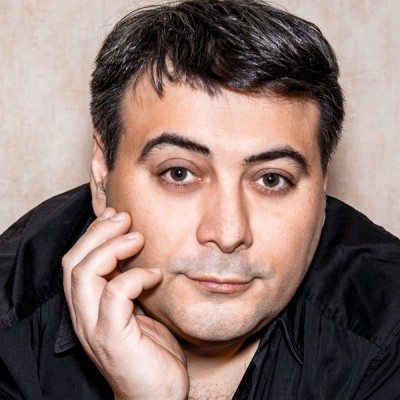
It was in the mid nineteen nineties that one suddenly noticed, within the vibrant quintet of Stefano Di Battista, constantly punctuating, enriching and fueling the alto saxophonist’s voluble and fiery discourse, a young pianist as discreet as he was talented: Eric Legnini. A direct and generous style rooted in the black soul of jazz piano. A rich phrasing, both refined and sensual, always oriented toward song, voice, and melody. An exceptional sense of swing, supported by rhythmic rigor and sobriety worthy of the great hard bop masters. It took little time for Legnini to establish himself as the indispensable regulator of moods within Di Battista’s orchestra and to become one of the most sought after sidemen among the musicians gravitating around Paris’s Rue des Lombards.
Eric Legnini was born in Belgium on February 20, 1970, in Huy near Liège, into a family of Italian immigrants. An amateur guitarist father and a mother who was a singer and vocal teacher at the municipal conservatory meant that young Eric was at the piano from the age of six, spending his childhood between Bach and Puccini, between musical architecture pushed to its highest level of abstraction and the naked soul of the human voice transfigured by singing. He had to wait until the early nineteen eighties and the discovery of a record by Erroll Garner to glimpse other musical horizons, particularly in the art of the keyboard. Gifted with an excellent ear, he reinvented at the piano the unusual harmonies he captured by ear and quickly fell under the spell of jazz. Eric had found his language.
An intense period of learning followed. With the complicity of a conservatory friend, drummer Stéphane Galland, and soon after Fabrizio Cassol, two musicians who years later would form the experimental group Aka Moon, Eric Legnini embraced the entire history of modern and traditional jazz with the same thirst for discovery and quickly built his own personal pantheon. McCoy Tyner for dramatic intensity, Chick Corea for clarity and flawless technique, and Keith Jarrett for his revolutionary approach to reinterpreting standards. Always alongside Stéphane Galland, he formed his first jazz and fusion groups and from the mid nineteen eighties played in all the clubs of the Belgian scene in search of jam sessions of every style in order to hone his skills.
In 1987, he met one of the major figures of Belgian and European jazz, saxophonist Jacques Pelzer, who invited him to play in duo and then to join his group. This decisive and formative step forced the young pianist to deepen his knowledge of the standard repertoire and propelled him among the most promising sidemen of the young Belgian scene. He recorded his first album as a leader for the Igloo label, Essentiels, and soon after decided to leave to study in the United States.
It was 1988 and Eric was barely eighteen. He spent two years in New York, long enough to feel the very funky pulse of the city at a time when rap by Public Enemy and Ice T was emerging, another great passion of Legnini. He took a few classes at Long Island University with Richie Beirach, but above all learned the craft by experience, taking part every night in legendary jam sessions alongside the finest young jazz musicians of the time, including Vincent Herring, Branford Marsalis, and Kenny Garrett. Deeply impressed by the precise and voluble style of Kenny Kirkland, Legnini came to understand through him the decisive importance of Herbie Hancock in the history of jazz piano and from that moment radically oriented his playing toward the modern free hard bop aesthetic of the Blue Note sound of the nineteen sixties.
Under the dual influence of Kirkland and Hancock, Eric Legnini returned to Belgium in 1990. He was immediately appointed piano professor in the jazz section of the Conservatoire Royal de Bruxelles. He reunited with Jacques Pelzer to record a new album for Igloo, Never Let Me Go, and soon after joined the orchestra of Toots Thielemans, with whom he accumulated concerts and tours around the world for nearly two years. Multiplying projects in all directions, and beginning at that time to work extensively in studios for funk, rap, and electronic music sessions, Eric Legnini became a cornerstone of the Belgian jazz scene.
In 1992, his life took a decisive turn when he met two Italian musicians in a Brussels club, then members of the Orchestre National de Jazz directed by Laurent Cugny: trumpeter Flavio Boltro and saxophonist Stefano Di Battista. The chemistry between the three was immediate and they decided to work together at once. Why not form a group and try their luck in Paris?
At the end of 1993, it was the leap. Di Battista and his orchestra set out to conquer the French capital. A seductive and resolutely hard bop repertoire, contagious energy, talent, and joy of playing allowed them to win over audiences in just a few months. Aldo Romano noticed them and took them under his wing. The success was meteoric. A first album, Volare, released in 1997 on Label Bleu and unanimously praised by critics, firmly established the young quintet as the new group everyone was talking about.
For Eric Legnini, this marked a new beginning. An indispensable pianist to the balance of the quintet, he remained the faithful companion of the Italian saxophonist until the album Round About Roma released on Blue Note in 2003. His reputation quickly grew among fellow musicians.
In high demand, he began long term collaborations with the Belmondo brothers, Eric Lelann, and Paco Sery. Frequently associated with drummer André Ceccarelli, he became one of the most sought after sidemen on the Paris scene, accompanying artists such as Joe Lovano, Mark Turner, Serge Reggiani, Aldo Romano, Enrico Rava, Philippe Catherine, Didier Lockwood, Henri Salvador, Christophe, DJ Cam, Sanseverino, John McLaughlin, Ivan Lins, Mike Stern, Bunky Green, Zigaboo Modeliste, Yusef Lateef, Raphael Saadiq, Manu Katché, Pino Palladino, Eric Harland, Kyle Eastwood, Joss Stone, Natalie Merchant, Raul Midon, Kurt Elling, Vince Mendoza, Michael Brecker, Dianne Reeves, Milton Nascimento, and many others. He also accumulated close to one hundred studio recordings.
Highly appreciated in the studio for his musicality and expertise, Legnini also began working as an artistic director on several popular music albums. This activity reached its peak in 2004 with the co production of the final album by Claude Nougaro, La note bleue, released on Blue Note, as well as the production under the pseudonym Moogoo within the Anakroniq collective of the debut album by French rnb revelation Kayna Samet, Entre deux Je, released on Barclay.
Notably recognized for his participation in the album Wonderland by the Belmondo brothers, awarded Best French Jazz Album at the Victoires de la Musique in 2005, and for his production work on Daniel Mille’s album Après la pluie, Eric Legnini is today not only one of the leading figures of European jazz, but also one of the most active, productive, and eclectic artists on the Paris music scene.
At the age of thirty five, in full stylistic maturity, Legnini decided to step out of the shadows and released Miss Soul, his first album as a leader on a French label. This album revealed a rich and personal musical universe, perfectly original in its ability to connect tradition and modernity, scholarly art and popular expression. Returning to the classic piano trio format with bassist Rosario Bonaccorso and drummer Franck Agulhon, Legnini explored an Afro American jazz piano tradition brought to its highest level by musicians such as Junior Mance, Ray Bryant, Les McCann, and Phineas Newborn, to whom the album pays continuous homage. A direct, warm music filled with swing and gospel that celebrates the timeless modernity of jazz without nostalgia.
In 2008, he completed the triptych Miss Soul and Big Boogaloo with Trippin’, establishing himself as a master of the French piano trio. This was followed by The Vox in 2011, an album centered on the voice and awarded a Victoire du Jazz. In 2013, he released Sing Twice!, nominated for the Victoires du Jazz, an album flirting with pop and featuring multiple voices.
Since then, Eric Legnini has continued his work as a composer and producer, collaborated with artists such as Kellylee Evans, played in all star groups, created major projects at Jazz à la Villette and Jazz à la Philharmonie, toured extensively, and released Waxx Up in 2017, confirming his evolution as both pianist and producer.
Waxx Up set a clear direction from its opening track, I Want You Back. Direct, groove driven, and focused on melody, the album affirms Eric Legnini’s enduring connection to black music culture and the vinyl tradition that has always been his raw material.