Shirly Laub
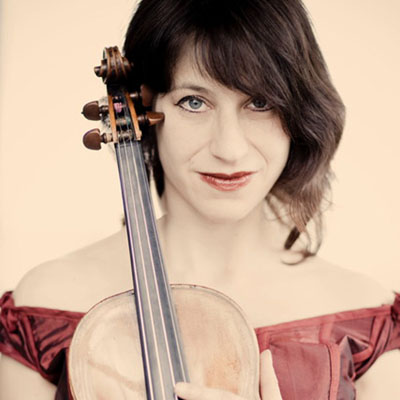
Biography
Shirly Laub studied in Brussels in the class of Clemens Quatacker at the Koninklijk Muziek Conservatorium and later continued her training with Wiktor Liberman and Philippe Hirshhorn in Utrecht. In 1997, she was awarded the title of Young Soloist of the French speaking public radio communities, and in 2001 she became a Juventus laureate, a distinction awarded by the Council of Europe. She has recorded as a violin piano duo partner, chamber musician, and leading violinist for the radio stations Musiq’3, Klara, Concertzender (Netherlands), Radio Classique France, France Musique, Radio Suisse Romande, Radio Canada, RAI, and the BBC, as well as for the labels Explicit! and Fuga Libera. In 2001, she joined the Silk Road Ensemble in New York, performing chamber music with Yo Yo Ma around the world.
She served as concertmaster of the Royal Philharmonic Orchestra in London from 1998 to 2005 and is regularly invited as concertmaster at the Royal Opera House Covent Garden, with BBC orchestras, and with the main Belgian symphony orchestras, as well as in France, the Netherlands, Spain, and Korea. Her activities as a soloist and chamber musician, notably as founding first violin of the ensemble Oxalys since 1993 and as a member of the string trio TrioFenix, have led her to perform in prestigious venues worldwide, including the Concertgebouw in Amsterdam, the Konzerthaus in Berlin, Wigmore Hall in London, and the Library of Congress in Washington. As a guest professor, she has taught at the Royal College of Music and Trinity College of Music in London, as well as at conservatories and universities in Madrid, Kumamoto in Japan, Beijing in China, Miami in the United States, and through numerous international masterclasses. She has also been Professor of Violin at the Conservatoire Royal de Bruxelles since 2003. Her pedagogical approach is based on developing artistic potential through instrumental mastery, allowing artistic expression without physical obstacles. As a guide in this learning process, she emphasizes mutual respect and the development of effective personal practice management, so that the artistic research that characterizes an artist’s entire life does not end with formal studies.