Benoît Chantry
Biography
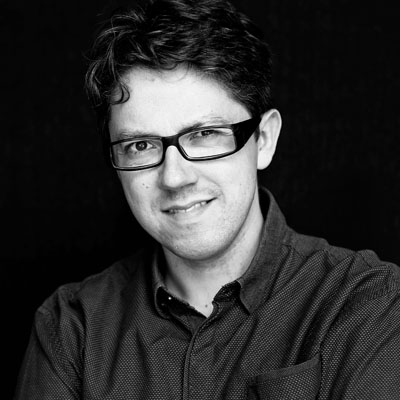
From a very young age, Benoît Chantry studied several instruments and developed an interest in different musical styles. After honing his skills at the Conservatoire royal de Bruxelles (percussion, music theory, composition, conducting, jazz), he entered the music world with the goal of bridging genres. Bringing together artists from diverse backgrounds, he has created musical performances (Festival de Wallonie, Lille 2004, Mons 2015, etc.), music for events (Rencontres inattendues, La Voix de l’Air, etc.), musical storytelling, and scores for theater and documentary films. Fascinated by the balance between the written and the unwritten, he collaborated with Tunisian oud player Ziad ben Youssef to create the music for the show Les Contes des Sages du Désert.
His creative drive—which he also channels into compositions commissioned by renowned orchestras and soloists—has taken him in various directions: he has worked with the Musiques Nouvelles ensemble and the European Contemporary Orchestra; his compositions for wind orchestra, often evocative or descriptive, are performed on several continents and have given him the opportunity to represent Belgium as part of the Wind Orchestra World Project, initiated by the MUI Foundation (P-B).
His desire to share his passion—which he puts into practice when conducting orchestras or teaching classes of students—also takes him into very different worlds: he has conducted some twenty ensembles, including the Royal Chamber Orchestra of Wallonia, the Chapelle Musicale de Tournai, the Nuove Musiche ensemble, the Conservatoire royal de Bruxelles Orchestra, the Ensemble Divertimento (Eurométropole), the Hageland Wind Orchestra, the Contrastes Ensemble, the Ad Hoc Wind Orchestra, and the Royal Navy Band of Belgium, both in concert and in the studio. As a percussionist or conductor, he has premiered works by Aperghis, Capelletti, Reich (Belgian premiere), Dusapin, Dupraz, Houben, Lysight, and others. He won the composition prize at the European Jazz Contest in 1999 and the Composition Prize from the Hainaut Music Federation in 2007 and 2009.
He teaches composition at the Conservatoire royal de Bruxelles. The approach he offers his students—whose primary goal is the mastery of tonal language—begins with the analysis of works from the repertoire. With a constant focus on making the course content accessible, he encourages students to deepen their understanding of their own repertoire by drawing connections between the compositional syntax chosen by the composer and the underlying intent that results from it.