Fabrice Alleman
Biography
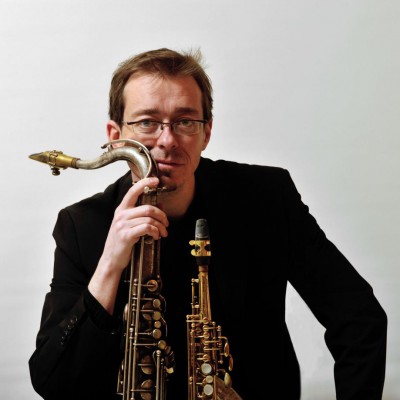
Born in Mons in 1967, Fabrice Alleman was already performing at the age of 13 with the Harmonie de Ghlin, where he played the clarinet. He recorded his first release, a 45-rpm single entitled “El’ Berdelleu,” in 1984 with a Dixieland band. Influenced by jazz from an early age thanks to trombonist Jean-Pol Danhier, he won his First Prize in clarinet and his First Prize in chamber music at the age of 18. During his military service as a musician, he joined big bands, chamber music ensembles, and blues bands. Leaving the clarinet for a time to take up the saxophone, he began his career on the Belgian jazz scene through the workshops of Les Lundis d’Hortense, then enrolled in the jazz department of the Conservatoire royal de Bruxelles, where he obtained his First Prize in saxophone in 1992. He teaches clarinet and saxophone in various academies while leading multiple projects: “Alleman-Loveri,” with guitarist Paolo Loveri for the album “Duo”; the “Fabrice Alleman Quartet,” with Michel Herr, Jean-Louis Rassinfosse, and Frédéric Jacquemin, whose album “Loop the Loop,” recorded both in the studio and live at the International Jazz Festival in Liège, received the “Nicolas d’Or” award in 1998 and was voted “Best Jazz Album of the Year.” In 1998, Fabrice Alleman was named “Best Soprano and Tenor Saxophonist” in a poll conducted by Belgian radio stations, and SABAM awarded him the “Belgian Artistic Promotion” prize. Demonstrating rare eclecticism, he multiplied encounters and styles, notably playing blues with the Calvin Owens Orchestra from 1992 to 1998; rock, ethnic music, and modern jazz with Stéphane Galland, Fabian Fiorini, and Michel Hatzigeorgiou; as well as pop music with Salvatore Adamo (album “Adamo Live,” 1996) and with the William Sheller group on tours in France and Switzerland.
From 1993 to 1998, he was a member of the group “Sax no End,” touring festivals and concerts in Germany, the Netherlands, and Belgium, where he met double bassist Jean Warland, with whom he would continue to collaborate: from 1999 to 2004 with “The ‘A’ Train Sextet,” and then with the “Jean Warland–Fabrice Alleman Duo,” which has continued to perform in Germany and Belgium to this day. Another memorable encounter took place earlier, in 1997, when he accompanied the Terence Blanchard Quintet and the Luxembourg Philharmonic Orchestra. The Alleman-Loveri Duo toured Nicaragua, Sweden, and Italy from 1997 until 2001, the year of the duo’s second album, “On the Funny Side of the Strings,” which subtly incorporates a string quartet. In 1999, he was given carte blanche at the Cap Sud Festival in Mons and created the first version of the “One Shot Band” with violinist Jean-Pierre Catoul, whose innovative spirit and freshness were highlighted in a remarkable series of concerts from 1999 to 2001. That same year, he took part in Michel Hatzigeorgiou’s “Jaco Pastorius Project” at the Middelheim Festival in Antwerp and at the Gaume Jazz Festival alongside Toots Thielemans, Otello Molina, and others. Numerous tours in Belgium and abroad followed. In 2004, the Fabrice Alleman Quartet released its second album, “Sides of Life,” featuring trumpeter Bert Joris, guitarist Peter Hertmans, and a string quartet. The album was ranked “Top CD” by Jazzmosaiek magazine.
In 2006, the Fabrice Alleman Quartet, together with Philippe Catherine’s group, represented Belgium at the Warsaw Jazz Summer Days Festival in Poland. That same year, trumpeter Randy Brecker joined the Quartet at the International Jazz Festival in Liège for an unforgettable concert broadcast by RTBF (aired in 2007). In 2004, Fabrice Alleman performed eight concerts with the San Severino Jazz Project at La Maroquinerie in Paris; this successful experience undoubtedly led Stéphane Sanseverino to call on him two years later to conduct the brass section of his Sanseverino Big Band for the stage, recorded on the 2006 album “Exactement.” Among Fabrice Alleman’s many musical activities are also numerous recordings of film music, notably composed by Michel Herr, as well as recordings with the WDR Big Band in Cologne and at the Leverkusen Festival with Nina Freelon, Hiram Bullock, and Kenwood Dennard.
2017: Launch of the cross-disciplinary project “UDiverse” with the Liège Chamber Orchestra.
He is currently working on an ambitious project: a triptych titled “SPIRIT,” which seeks to answer the question, “What does it mean to be an artist today?” The first installment, “Spirit One: Clarity,” was released in 2022 (featuring, among others, Philip Catherine); the second installment (“Spirit Two: NOW!!”) is set to be released in 2027 and focuses on current pressing issues. He collaborates with musicians from all over the world, including a rapper and a slam poet.