Fabrice Rodriguez
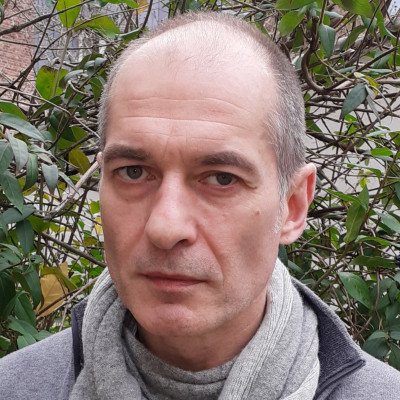
Biography
More than 35 years ago in Dijon, a friend who was passionate about theatre asked Fabrice Rodriguez to play opposite him in a scene from Waiting for Godot for an audition. It was the first time he had ever been on stage, and it was a revelation, the catalyst that convinced Fabrice Rodriguez that this would be his profession: actor. Three years later, after taking classes at the Théâtre du Rameau d'Or and the Nouveau Théâtre de Bourgogne, joining an amateur theatre company, participating in the creation of the Ligue Bourguignonne d'Improvisation and his first semi-professional show, Fabrice Rodriguez came to Brussels to study at INSAS.
Several encounters proved decisive for him: Jean-Michel D'Hoop, who was in his class and with whom he began the Point Zéro adventure and went on to create more than fifteen shows together; Thierry Salmon, his mentor, first as a teacher and then as a director; and Jean-Claude Berutti, who hired him for his first professional show in a Goldoni diptych at the Théâtre National de Belgique and the Théâtre National de Strasbourg. This was followed by more than sixty plays by classical and contemporary authors, from Aeschylus to Paul Pourveur, including Shakespeare, Pasolini, Neil Labute, Alexis Michalik, Strinberg, Juan Mayorga, Jodorowsky, Jean Louvet, Ionesco, Ibsen, Ahmed Ghazali, Chekhov, and Lars Noren, to name but a few, with directors such as Isabelle Pousseur, Frédéric Dussenne, Christophe Sermet, Christine Delmotte, Michael Delaunoy, Philippe Sireuil, Jasmina Douieb, and Christian Leblicq.
Cinema also plays an important role for Fabrice Rodriguez, who has worked on numerous feature films, series and short films with directors such as Sébastien Lifshitz, Olivier Smolders, Delphine Noels, Ariel Zeitoun, Vivian Goffette, Martine Doyen, Gary Segers, Matthieu Frances, Marc Schaus and Jean-Marc Moutout. After all these years, Fabrice Rodriguez's desire to meet new people and take on new projects rich in meaning and poetry remains intact. His experience in teaching and educational research, particularly at the Conservatoire royal de Bruxelles where he lectures in dramatic art, is important both for the personal enrichment and pleasure it brings him and for the opportunity it gives him to share his experiences with the students participating in the workshops.